About This Blog

Showing posts with label stories. Show all posts

Thursday, April 16, 2020

Have You Tried Not Worrying About It? (The Trouble With Time Travel)

We went back... to Back to the Future!
In this brave new world of quarantine-land, we as a species are looking for ways to kill time as we wait for our respective governments to solve this problem or, more realistically, for COVID-19 to get bored and go away. It is in that spirit that I turn to this post, and it is that same spirit that my 13 year-old daughter Gabby has decided she wants to watch the Back to the Future trilogy.

My wife Jaime and I have returned to a number of our favorite older movies while sheltering-in-place here in Brooklyn, NYC. I'm happy to report that Ferris Bueller's Day Off and The Birdcage both hold up and you should revisit (or visit) them ASAP. Back to the Future also holds up.

And then there's Back to the Future Part II.

Yikes.

Back to the Future Part II is kind of a mess, and side note: all of the old-age make-up is horrifying. Everyone in the movie's version of 2015 looks like a Dark Crystal character or one of those creepy battery people from the old Duracell ad campaign.
Oh man.
Puppet-faces aside, though, I have to admit that by the end of our viewing? I was on board. By the time credits rolled on Part II I couldn't help but smile at the extremes to which the film had embraced time travel and all of the baggage that comes with it. By baggage I am referring, of course, to time paradoxes: the continuity-shattering realities of writing a story in which the chronological order of events no longer has any meaning.
Back to the Future takes place in two times (1985 and 1955) and establishes for itself a pretty straightforward time rule based on the well-known Grandfather paradox: if you go back in time to kill your grandfather then you'll never be born to go back in time and kill your grandfather. In the first film, protagonist Marty McFly is sent back in time 30 years to 1955, where he accidentally interferes in his parents meeting for the first time and has to remedy that over the course of one week lest he end up fading from existence. If he traveled back in time and kept his parents from falling in love, then how was he ever born to travel back in time? Grandfather paradox. Even this relatively simple plot leads to paradoxes on top of paradoxes. For example: if Marty keeps his parents from meeting then why did he slowly fade from existence over a week instead of instantly disappearing? The answer, obviously, is because storytelling. In stories, countdown timers are more interesting than abrupt endings.

This still owns, though.
Back to the Future Part II, though, makes the first film seem like a slow-moving period drama by comparison. Part II sends Marty and Doc through 1985, 2015, an alternate 1985, back to 1955 and the events of the first movie, and then to top if off Doc gets hit by lighting while in the DeLorean and ends up in 1885 (although we, the audience, won't get to join him there until Part III.) This second film in the trilogy is busy as all hell, and if you're not somebody who has already spent a chunk of your life thinking about time travel (for example, my wife) you're probably going to have trouble following along with the story.

The key to understanding fictional time travel, I've found, is to stop trying to understand it. This is very difficult for some of us in a canon-obsessed audience, particularly for those of us raised on comic books, where every story across a publisher's line of books has "happened" in the same universe and the events of one effects the events of another. Characters revisiting their past or visiting their future is simply too ripe a storytelling opportunity to avoid picking from time to time, and the simple truth is that unless the time travel rules of a particular fictional universe are established as being the linear rules of time travel (that is, what happens happened, and what happened happens, and time travelers can't change the future or past but simply observe it from a different point of view) then the moment characters are sent forwards or backwards in time narrative paradoxes are going to pop up. It is inevitable.

Back to the Future Part II contradicts itself in a number of ways. Marty and Doc have to change events in the past to travel forward to a new future, but when old Biff changes events in the past he then returns to a 2015 that seemingly hasn't changed to reflect the drastically different new future his actions created. This chapter in the series leans HARD into characters jumping around through the time stream to effect change, but those changes only seem to occur when appropriate for the narrative.

Which is, of course, the best way to do that if you're trying to tell a good story.

Time travel in fiction is the perfect example of a valuable rule of story consumption that I think we've come to forget in a post-MCU world: exposition makes bad storytelling, so sometimes you have to let go of the background minutiae and just enjoy a story for what it is. Contradictions are going to occur in fiction, almost always. If that's something that bothers you, the simplest solution to ensure that you're able to continue enjoying your stories, time travel or otherwise, is to stop thinking so much about them.
At least they never tried to explain how this thing works.
P.S. - My favorite use of time travel in fiction is in Douglas Adams' novel Mostly Harmless, part of the Hitchhiker's Guide series, in which the inevitable millions of time paradoxes generated by easily available commercial time travel have led the universe to the brink of collapse because nothing within it makes sense anymore. I just love the conceit of a series of books that leans hard into time travel while at the same time acknowledging that time travel is straight narrative nonsense.

P.P.S. - My LEAST favorite use of time travel in fiction is in Harry Potter and the Cursed Child, the stage play sequel to the Harry Potter series. Cursed Child relies heavily on Back to the Future Part II style time-travel to drive its plot, when it was clearly established in Harry Potter and the Prisoner of Azkaban that time travel in the Harry Potter universe is linear in nature and grandfather paradoxes are NOT possible within it. Cursed Child ignores that rule in total, even though the same exact sort of magical talisman (the time turner) is used to time-travel in both the book and the play. Seriously, it's best not to think too hard about this stuff.


Wednesday, October 9, 2019

The Second Person

Choose Your Own Adventure books could go down some weird, weird paths.
I've used the language of video games more than once to illustrate points about literature. Take, for example, the basic literary element of point-of-view. First person point-of-view is when the narration of a story refers to the main character as "I", and third person point-of-view is when the narration of a story refers to the main character as "he" or "she" or some other non-gendered pronoun. Video games are also described in terms of being in either first or third person. A first person game puts you directly into the head of the avatar, and you see the world through their eyes. A third person game puts you outside of the avatar you're controlling, often directly over their shoulder.

Lesser known, and even lesser used in literature, is SECOND person point-of-view. A story told in second person is one where the narration refers to the main character as "you." The most famous application of second person POV may be in old school Choose Your Own Adventure stories, the ones that start with passages such as, "You wake up in an abandoned mine shaft. After dusting off dirt, debris, and spiders, you look around. To your left, the shaft heads towards a light. To you right: darkness. Which way will you go?" The text then offers the reader an option: "To go left, turn to page 28. To go right, turn to page 33," and the rest of the story unfolds in this manner, inviting the reader to go back and re-read the book many times over, experiencing a different story each time. The virtual world in the pages of the books is laid out by the author, and you, the reader, get to decide how you experience that world.

I'm wondering if you're starting to see the connection.

It is a connection that clicked for me when I was playing a video game that 1.) I've been playing recently, 3.) I'm way too late to the party on, and D.) is awesome. The game in question: Portal 2, a game about being trapped in an abandoned laboratory and solving environmental puzzles by using a gun that fires reality-bending teleportation portals onto walls. Portal 2 features arguably the greatest character in video game history. No, not the player avatar. The player avatar is a silent protagonist named Chell about whom very little is known. She's importantly unimportant, though, so we'll come back to her in just a bit. I'm speaking of GLaDOS, the wickedly scripted and voiced AI character who runs the dead lab where Chell is imprisoned. GLaDOS is delightfully insane, and her history and past are really at the heart of the world of Portal. In the first game in the series, she is the clear-cut antagonist; in the second, she could still be called such (although more shades of grey reveal themselves as that story unfolds.) As you, the player, in the person of Chell, puzzles your way through Aperture Labs, GLaDOS taunts you and leads you astray, all the time referring to you, as "you".
Portal 2
That alone doesn't mean, "Hey! Video games are all told in the second person!" First person games are so characterized because they ask the player to control a character into whose head the game's "camera" has been directly placed, and Portal 2 is very much a first-person game in that regard. And Portal games aren't necessarily Choose Your Own Adventure books; they're actually pretty linear in their progression as you solve their room-based puzzles in a pre-determined sequence. Portal and Portal 2 both, however, present a story told through the characters in front of you and the world around you. Much of the game's lore is delivered through environmental clues, graffiti tucked away in out-of-the-way corners and on television monitors that come to life in the background of the areas you explore, and it is entirely up to you how much of that part of the story you experience. The series' main character, Chell, is a cipher. Her character appearance is set, but she's a blank slate for you to write on, a vessel through which you experience the game's adventure. She is literally a shell. That's right. Chell is a shell. Valve isn't being subtle here, just as they neglected subtlety in their hit game Half-Life, where protagonist Gordan Freeman is a free man.

Another great example of choosing-your-own adventure gaming occurs in medieval fantasy game Skyrim, one of the most successful single-player video games of all time. In Skyrim you choose your race, your gender, your facial features, the literal and figurative paths you take, the disciplines you learn, the factions in the in-game world you're going to team up with, which ones you'll oppose, and which ones you'll avoid altogether... everything. You do all of this without your player avatar ever saying a word. Everything is a variable, and the world responds to and is shaped by your choices and actions. The game tends to get buggy for that very reason (it needs to be a remarkably malleable piece of programming to try and predict for everything the player may choose to do), but that's the price developer Bethesda Softworks was willing to  pay for developing an open-everything game. Spoiler warning: it totally worked out for them.

Skyrim
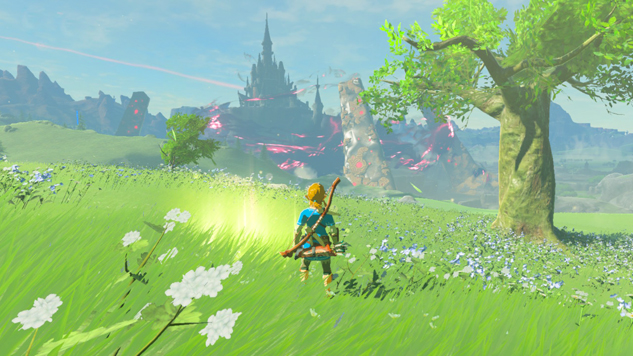
And then there's Nintendo, the granddaddy of gaming. Storytelling that presents you, the player, with a world and then steps back to allow you to react to it... that's a storytelling style Nintendo has embraced for a long time. Think of Nintendo's hit franchise, The Legend of Zelda, and its protagonist, Link. Just as Chell is an empty shell that the player is invited to inhabit in order to experience her story, Link is the graphical avatar standing in as the link between the player and his world. Both Chell and Link are silent and seemingly emotionless, and this is so for a very particular reason: both Valve and Nintendo are asking you to react to the game worlds around these avatars with your OWN thoughts, feelings, and responses, not with pre-scripted ones voice-acted for you in cut scenes.

Portal 2 and The Legend of Zelda: Breath of the Wild are both games that allow gamers to take control of a silent avatar and explore a meticulously detailed and designed world. When I'm playing Portal or Portal 2 and I stumble across some cryptic graffiti left behind in a cranny warning me not to trust GLaDOS, it's far more effective for the game to sit back and let me respond emotionally and intellectually to this narrative turn as opposed to cutting away to a scene that rips me out of Chell's head and shows me a character I've been role-playing as reacting to the scenario in a way I never would. Same goes for Breath of the Wild. There's two forms of storytelling in Breath of the Wild. There are traditional cut scenes that have been criticized and discussed and which sometimes feel awkward and out-of-character and out of place... and then there's the atmospheric storytelling that unfolds over the course of hundreds of hours of gameplay across the massive, history-laden, go-anywhere kingdom of Hyrule. I don't know about you, but I find exploring a field full of petrified enemies in front of a rotting barricade a far more compelling narrative experience than a cut scene where a bird in a smock makes snide comments to me.

The Legend of Zelda: Breath of the Wild
It stands to reason, when you think about it, that the ideal storytelling in an interactive medium would be interactive, rather than a series of cinematic scenes that rip control away from the player just as the most interesting parts of the story begin to happen. So flesh out your virtual worlds, game developers, as richly as you can, and when you drop me into it, don't signpost me to death. Don't dictate to me how your game should make me think, feel, and react. Just let me run loose and tell me, "You can go left or you can go right. Which way will you go?"

Saturday, October 5, 2019

What is Storytalking?

Storytalking is a blog about storytelling.

To be clear: it is not a blog where stories will be told. It is a blog wherein we will discuss how humans tell stories, stories in all of their varied forms.

My name is Tom Hoefner. I’m a playwright, a teacher, a theater director, a novelist... a husband, a father, a brother, a son, a friend... a carbon-based lifeform, an American citizen, a lapsed Catholic, a basic white guy, a 40 year-old, a cat owner, a stay-at-home dad... and yes, I'm also a storyteller.

And I’m also a fan. Of stuff. Lots of stuff. Primarily, stuff through which stories are told: theater, comic books, video games, professional wrestling, professional sports, movies, music, television, books, etc., etc., all of which are but a few of the mediums that human beings, over the course of our existence on this planet, have adapted into mediums for storytelling.

We, as a species, need stories. Like oxygen, water, and nourishment. Stories feed the mind. We live an existence of chaos and disorder, of illogic and poor reasoning. Things happen in this world, good things, bad things, every-thing... and we are obsessed, as a species, with figuring out, “why?” even though the answer to that question is so very often, “why not?”

Our answer to a world where meaning is hidden and disorder reigns, has been for eons to create alternate realities where life has purpose and events unfold in a clear, cause-and-response, neat and orderly fashion.

We tell stories.

And this blog is a place where we’re going to talk about them.